Analyse
14 juillet 2017

La loi Sapin II, une nouvelle source de responsabilité pour les entreprises et les particuliers (En anglais)

Bastille Day Newsletter 2017 - Legislative Updates


The “Sapin II” law has been designed as a defensive law against the extraterritoriality of foreign legislation (FCPA, UKBA). This new legislation is aimed at strengthening French judicial sovereignty by preventing – through the consolidation of the anticorruption framework – the sanctioning of French companies by foreign judicial and regulatory authorities. The law also aims at avoiding leaking of strategic information and economic espionage when a foreign monitor is appointed.

Starting on June 1st, 2017, large French companies and foreign subsidiaries of French groups (over 500 employees and an average annual turnover over €100 million) have to implement mandatory compliance programs to prevent and detect corruption (code of conduct, internal reporting procedure, risk mapping, etc.).

Compliance with these provisions will be monitored and sanctioned by the new French Anticorruption Agency (AFA) – whose organization is somewhat clarified by the Decree of March 15, 2017 – endowed with increased resources and headed by judge Charles Duchaine. The AFA will have the power to impose injunctions and fines of up to 200.000€ for individuals and €1 million for legal persons.

An additional compliance-related penalty (monitorship) may also be imposed to legal persons convicted for offences of corruption or influence peddling.

If medium and small-sized companies do not yet fall within the scope of this compliance obligation, they are already subject to the implementation of internal reporting procedures.

Companies with over 50 employees will have to ensure whistleblower protection (broadly defined by the law) and implement graduated internal reporting procedures under the penalty of incurring civil or criminal liability. Companies will have to guarantee the anonymity of the whistleblowers and of the person identified as well as the confidentiality of information.

The “Sapin II” law also introduces into French law the possibility of signing a convention judiciaire d’intérêt public (‟French DPAˮ) – proposed by the Public Prosecutor before the initiation of criminal proceedings or by the investigating magistrate when an instruction is ongoing – for select probity offences [See on this topic “CJIP: the French DPAˮ].

The “Sapin II” law also provides a framework for lobbyists with the creation of a digital register of “interest representatives” (i.e., lobbyists) to the High Authority for the transparency of public life (HATVP). The draft Decree which has been leaked to the press, however, shows significant shortcomings. Interest representatives will have no obligation to mention their public statements, the names of parliamentarians met or the date of their meetings, and the information covered by the register would only be published once a year.

The “Sapin II” law finally prohibits all – direct or indirect – advertisements for high-risk financial products sent by email and likely to reach individual investors. Operators incur a fine of up to €100.000. The French Financial market authority (AMF) recently defined the categories of financial contracts covered by this measure (binary options, contracts for difference (CFD) and financial currency contracts (Forex)).

These new compliance obligations imposed on companies are part of a wider trend towards transparency and corporate accountability, as outlined by the enactment of the law No 2017-399 on the duty of care of mother companies on March 27 [See on this topic “Duty of care of parent and contracting companies law”].
Contenu similaire

Publication
29 janvier 2026
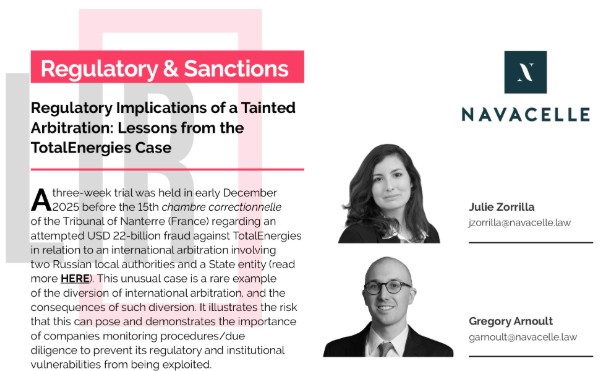
Les conséquences réglementaires d’un arbitrage frauduleux : leçons de l’affaire TotalEnergies
Navacelle contribue au magazine The Legal Industry Reviews, dans sa section "Regulatory and Sanctions", en présentant un exemple rare de...
Analyse
5 décembre 2025
La future directive 2023/0135 (COD) relative à la lutte contre la corruption
La Délégation des Barreaux de France publie dans son dernier numéro de l'Observateur de Bruxelles un dossier complet consacré à...
Analyse
5 novembre 2025
Une proposition de loi pour moderniser et renforcer les pouvoirs de l’AMF
Le 16 septembre 2025, une proposition de loi a été déposée à l’Assemblée nationale visant à accroître les pouvoirs de...
Publication
27 avril 2026
Lafarge : Une décision marquante pour le droit pénal des affaires et les systèmes de...
Dans un article co-écrit, publié dans le Global Investigation Review (GIR), Stéphane de Navacelle met en lumière une évolution...
Revue de presse
24 avril 2026
Revue de presse – Semaine du 24 avril 2026
La revue de presse de cette semaine revient sur la perquisition des locaux d’Engie dans le cadre d’une information judiciaire...
Analyse
22 avril 2026
Corruption: ce que révèle l’Indice de perception de la corruption 2025 de Transparency International...
L’indice de perception de la corruption 2025, publié par Transparency International, met en évidence une baisse de la moyenne...
Revue de presse
17 avril 2026
Revue de presse – Semaine du 17 avril 2026
La revue de presse de cette semaine revient sur la condamnation par le tribunal correctionnel de Paris de trois personnes...
Événement
17 avril 2026
[GACS 2026] Enquêtes 2026 : de l’alerte à l’investigation. Comment allier concrètement conformité avec...
Table ronde consacrée aux enquêtes internes, organisée par Business & Legal Forums, dans le cadre du Global Anticorruption & Compliance...
2 min
Publication
14 avril 2026
Les coûts de l’arbitrage : comment les maîtriser et les anticiper ?
Maxime Desplats, dans un article consacré aux coûts de l’arbitrage publié dans la section Arbitrage et Médiation de la Revue...
Revue de presse
10 avril 2026
Revue de presse – Semaine du 10 avril 2026
La revue de presse de cette semaine revient sur l’adoption en première lecture du projet de loi de lutte contre...
Analyse
9 avril 2026
Accords de non-débauchage et pratiques anticoncurrentielles : retour sur la décision du 11 juin 2025...
Dans un contexte de vigilance accrue des autorités de concurrence à l’égard des pratiques affectant les marchés du travail, un...
Revue de presse
3 avril 2026
Revue de presse – Semaine du 3 avril 2026
La revue de presse de cette semaine revient sur l’adoption par le Parlement européen de la première directive anticorruption de...
Événement
3 avril 2026
Le blanchiment d’argent à l’ère de la cryptomonnaie
Conférence sur la lutte contre blanchiment d'argent, présentée aux étudiants du Master 2 Droit pénal économique et de la conformité...
2 min
Analyse
31 mars 2026
CACEIS Bank : Décision de la Commission des sanctions de l’AMF du 17 décembre 2025
Après l’affaire H2O AM qui avait donné lieu à une sanction de cette société de gestion en 2022, l’AMF s’est...
Événement
30 mars 2026
[PAW 2026] La nouvelle géopolitique de l’arbitrage
Conférence sur la nouvelle géopolitique de l'arbitrage, tenue au Tribunal des activités économiques de Paris dans le cadre de la...
2 min