Une illustration du pouvoir disciplinaire de l’employeur en cas de non-respect des règles internes de l’entreprise (En anglais)
Bastille Day Newsletter 2021 - Enforcement & Court Decisions
On 11 March 2021, the Court of Appeal of Angers issued an interesting decision on the consequences of a non-compliance with internal company procedures by an employee, ruling that did not constitute a serious misconduct but that such misconduct likely to give grounds for a real and serious cause for dismissal under French labor law[i].
I. The employee committed by not following the internal policies a fault of such a nature as to give a real and serious cause to his dismissal
In France, an employer can only dismiss an employee if he can prove a real and serious cause for such dismissal[ii], i.e., an objective cause which is sufficiently important to justify the termination of the employment contract[iii].
Serious cause for dismissal should not be confused with the notion of serious misconduct, which is defined by case law as facts constituting a breach of obligations resulting from the employment contract of such importance that they make it impossible for the employee to remain in the company[iv].
In the case at hand, a company dismissed its sales and marketing manager of an armament company for serious misconduct, on the grounds he had arranged a meeting to sign an international contract with a distributor based in the United Arab Emirates, without respecting the internal control procedure in force, which provided for an obligation to alert the management and due to the fact that the contract was not validated either in form or in substance, thus exposing the company and its managers to particularly high risks[v].
Whereas in the first instance, the court had considered that the dismissal was devoid of real and serious cause, the Court of Appeal of Angers, on the contrary, judged that the sales and marketing manager, with regard to his level of responsibility and the particular nature of the activity of the company, had committed by not going through the validation process, a fault of such a nature as to give a real and serious cause to the dismissal[vi].
But, on the other hand, the Court of Appeal considered that there was no reason to qualify the dismissal of serious misconduct since, even if the breach committed was a faulty abstention in view of the context, it did not reflect any bad faith or disloyalty on the part of the sales and marketing director and did not have the effect of putting the company in a situation of serious and immediate danger so that it was impossible to maintain his employment contract[vii].
II. An illustration of the exercise of the employer’s disciplinary power in case of breaches of internal policies
Beyond the employment law aspect of this decision, this decision has great consequences regarding the enforcement and execution of compliance requirements resulting from the law n°2016-1691 of 9 December 2016 on transparency, fight against corruption and modernization of economic life (called “Sapin 2” law) and it makes it an interesting decision for the fight against corruption.
Indeed, article 17 of this law requires, mainly companies with more than 500 employees and revenues of more than 100 million euros, to take measures to prevent and detect the commission of acts of corruption or influence peddling among which the establishment of a disciplinary system allowing the company’s employees to be sanctioned in the event of a violation of the company’s code of conduct[viii].
This decision is thus an illustration of the exercise of the employer’s disciplinary power in case of breaches of internal anti-corruption and influence peddling procedures. It is a reminder of the importance of the prevention system and the zero tolerance that should be applied in view of the risks incurred by companies, as the Court of Appeal underlines by specifying that the sales and marketing director committed “a clumsiness revealing a poor appreciation of the extent of his responsibilities which could have had unfortunate consequences for the company”[ix].
While some may regret that the judges did not find serious misconduct in the failure to comply with internal compliance procedures, the fact remains that the decision reflects an important consideration of the latter. In any event, this is the illustration that compliance requirements take an ever more important place.
Contenu similaire
Revue de presse
18 septembre 2026
Revue de presse – Semaine du 14 septembre 2026
La revue de cette semaine revient sur l’ouverture du procès pour corruption de Rachida Dati et Carlos Ghosn devant le...
Revue de presse
11 septembre 2026
Revue de presse – Semaine du 7 septembre 2026
La revue de cette semaine revient sur la publication par l’Agence française anticorruption d’un guide pratique consacré à l’évaluation des...
Événement
11 septembre 2026
Stratégies contractuelles
Conférence dédiée aux étudiants du Master 2 Juriste d'affaires, éthique et compliance de l'Université Lumière Lyon 2.
Vidéo
8 septembre 2026
Décryptage de la décision du 9 juillet 2026 de la Commission des sanctions de l’Agence...
Julie Zorrilla, associée du cabinet Navacelle, est intervenue aux cotés de François Malan, lors d’un webinaire du Cercle de la...
Analyse
7 septembre 2026
Publication par l’AFA d’un guide pratique sur le dispositif d’alerte interne
Le 16 juillet 2026, l’Agence Française Anti-corruption a publié un guide pratique intitulé “Mettre en place un dispositif d’alerte interne...
Revue de presse
4 septembre 2026
Revue de presse – Semaine du 31 août 2026
La revue de cette semaine revient sur l’entrée en vigueur du régime des pénalités financières appliquées aux produits d’ultrafast-fashion, sur...
Revue de presse
21 août 2026
Revue de presse – Semaine du 21 août 2026
La revue de cette semaine revient sur la publication d’une circulaire du Premier ministre visant à renforcer la lutte contre...
Revue de presse
31 juillet 2026
Revue de presse – Semaine du 31 juillet 2026
La revue de cette semaine revient sur l’appel formé par TotalEnergies à l’encontre du jugement relatif au devoir de vigilance,...
Revue de presse
24 juillet 2026
Revue de presse – Semaine du 24 juillet 2026
La revue de cette semaine revient sur la décision rendue par le tribunal administratif de Paris relative au statut de...
Analyse
23 juillet 2026
La commission des sanctions de l’AFA prononce ses premières sanctions pécuniaires
La commission des sanctions de l’Agence française anticorruption (AFA) a, pour la première fois, fait usage de son pouvoir répressif...
Événement
13 juillet 2026
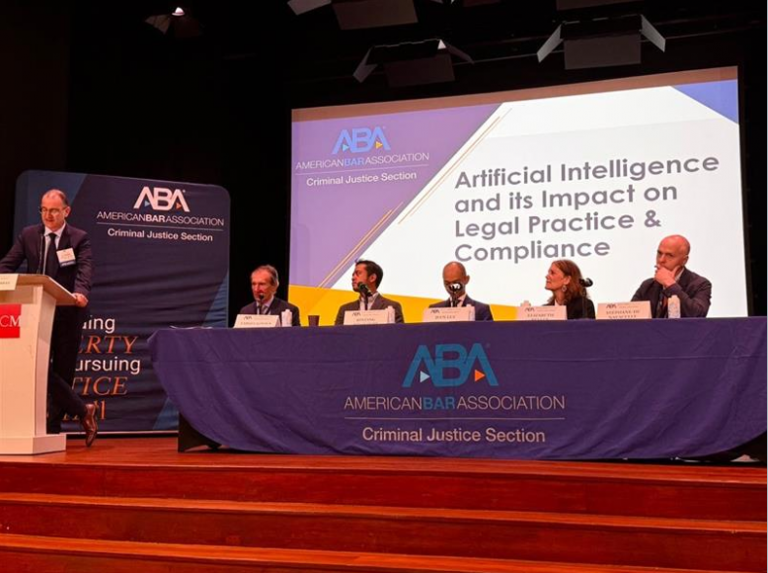
2026 Global White Collar Crime Institute -Singapour Plénière II : Intelligence artificielle et son impact...
Stéphane de Navacelle est intervenu lors du 2026 Global White Collar Crime Institute à Singapour, aux côtés de Zvi Gabbay,...
Revue de presse
10 juillet 2026
Revue de presse – Semaine du 10 juillet 2026
La revue de cette semaine revient sur la publication du rapport d’activité 2025 de l’AFA, la condamnation en appel de...
Nous utilisons des cookies pour optimiser notre site web et notre service.
Fonctionnel
Toujours activé
The technical storage or access is strictly necessary for the legitimate purpose of enabling the use of a specific service explicitly requested by the subscriber or user, or for the sole purpose of carrying out the transmission of a communication over an electronic communications network.
Préférences
The technical storage or access is necessary for the legitimate purpose of storing preferences that are not requested by the subscriber or user.
Statistiques
The technical storage or access that is used exclusively for statistical purposes.The technical storage or access that is used exclusively for anonymous statistical purposes. Without a subpoena, voluntary compliance on the part of your Internet Service Provider, or additional records from a third party, information stored or retrieved for this purpose alone cannot usually be used to identify you.
Marketing
The technical storage or access is required to create user profiles to send advertising, or to track the user on a website or across several websites for similar marketing purposes.