Analyse
14 juillet 2020

Un tribunal français approuve le licenciement d’un employé pour violation de la politique anticorruption de l’entreprise (En anglais)

Bastille Day Newsletter 2020 - Enforcement & Court Decisions


A company operating as spare-part supplier for the aircraft industry, dismissed its sales assistant after an internal investigation revealed that she had accepted and ordered two iPads from one of the company suppliers, violating the company’s internal anticorruption policy.

While the lower court ruled against the dismissal, Anger’s Court of Appeal followed the employer’s reasoning, considering that “by personally accepting gifts of a significant amount from a supplier, twice and with an absolute discretion”, the employee had committed gross misconduct that justified her dismissal [1].

With this decision, the Court took a stance in favor of companies that adopt a strict interpretation of anticorruption policy and sent a strong message to employees who put their employer at risk. The Court operates a sort of balance of interests by supporting companies’ internal anticorruption policies, although the company was not subject to anticorruption law standards.


I. A willful breach of internal anticorruption rules constitutes gross misconduct justifying dismissal

Pursuant to French labor law, employees cannot be dismissed without reason [2] and a minima, must be found guilty of substantiated misconduct. In the present case, the Court recalled that “gross misconduct results from a fact or set of facts committed by the employee involving a violation of the obligations deriving from [the employee’s] employment contract and of such importance as to make it impossible for [the employee] to remain in the company”.

Here, the identified misconduct is the result of cumulated circumstances. The employee was guilty of having breaching company internal anticorruption and ethical policy, by personally ordering two Ipads without consulting management and asking for them to be delivered at her personal residence.

Moreover, the Court highlighted that she willingly denied and withheld the order, all the while being aware of the company’s internal policy, as she had participated in several company trainings on ethics and anticorruption and had been provided with documents that expressly specified anticorruption provisions regarding gifts. According to these rules, accepting gifts was prohibited, except for gifts of a “reasonable value”, capped at twenty euros – while the iPads amounted to 798 euros. The internal investigation carried out by the company revealed, that the employee had issued a similar order with the same supplier two years earlier, for an electronic pad.

Although no act of corruption was identified – as not the role of the labor judge – this decision is an indication of the willingness to support company efforts to prevent litigious behavior on the part of their employees.


II. A decision in line with French anticorruption provisions

Pursuant to Article 17 of the Sapin II law, only companies with over five hundred employees are required to implement an anti-corruption policy [3], including a code of conduct, an internal reporting procedure, an internal control procedure, risk mapping and trainings.

Here, while the company is under the threshold imposed by law [4], it voluntary chose to implement an internal anticorruption and ethics policy. This shows that anticorruption is increasingly considered as important by small economic actors, namely on account of the serious consequences uncovered corruptive schemes may have (e.g. financial, reputational, and potential prosecution).

Although the risks of corruption are the mere backdrop of this case, the gross misconduct is characterized by the risks for the company. By dismissing its employee, the company chose to avoid such risks.
Contenu similaire

Publication
29 janvier 2026
Les conséquences réglementaires d’un arbitrage frauduleux : leçons de l’affaire TotalEnergies
Navacelle contribue au magazine The Legal Industry Reviews, dans sa section "Regulatory and Sanctions", en présentant un exemple rare de...
Analyse
5 décembre 2025
La future directive 2023/0135 (COD) relative à la lutte contre la corruption
La Délégation des Barreaux de France publie dans son dernier numéro de l'Observateur de Bruxelles un dossier complet consacré à...
Analyse
5 novembre 2025
Une proposition de loi pour moderniser et renforcer les pouvoirs de l’AMF
Le 16 septembre 2025, une proposition de loi a été déposée à l’Assemblée nationale visant à accroître les pouvoirs de...
Analyse
19 mars 2026
Retour sur la CJIP conclue entre la société HSBC et le PNF pour des faits...
Dans le cadre du dossier CumCum, le PNF et la société HSBC Bank plc ont conclu une convention judiciaire d’intérêt...
Revue de presse
13 mars 2026
Revue de presse – Semaine du 9 mars 2026
La revue de presse de cette semaine revient sur la condamnation de la société-mère du groupe Rocher pour manquement à...
Événement
11 mars 2026
Paris Arbitration Week 2026- La lutte contre les biais et le bruit, qui, inconsciemment, affectent...
Navacelle organise le 26 mars 2026, une conférence, dans le cadre de la Paris Arbitration Week (PAW).
Événement
10 mars 2026
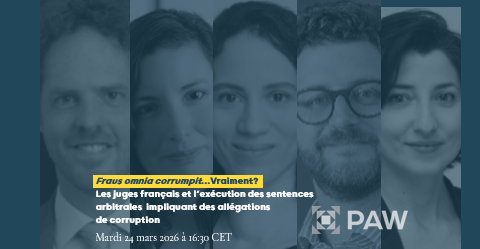
Paris Arbitration Week 2026- Fraus omnia corrumpit… Vraiment ? Les juges français et l’exécution des...
Navacelle organise le 24 mars 2026, une conférence portant sur les thèmes de la Corruption et de l'Arbitrage, dans le...
Revue de presse
6 mars 2026
Revue de presse – Semaine du 2 mars 2026
La revue de presse de cette semaine revient sur la conclusion d’une convention judiciaire d’intérêt public entre le Parquet national...
Analyse
3 mars 2026
Analyse de la chute du Président Maduro et de ses implications pour les créanciers du...
En ce début d’année, la chute du président vénézuélien laisse présager une intensification des initiatives des investisseurs étrangers au Venezuela,...
Revue de presse
27 février 2026
Revue de presse – Semaine du 23 février 2026
La revue de presse de cette semaine revient sur la procédure d’arbitrage engagée entre le Togo et le Ghana concernant...
Revue de presse
20 février 2026
Revue de presse – Semaine du 16 février 2026
La revue de presse de cette semaine revient sur le Groupe d’action financière (GAFI) qui salue les progrès de Monaco...
Publication
19 février 2026
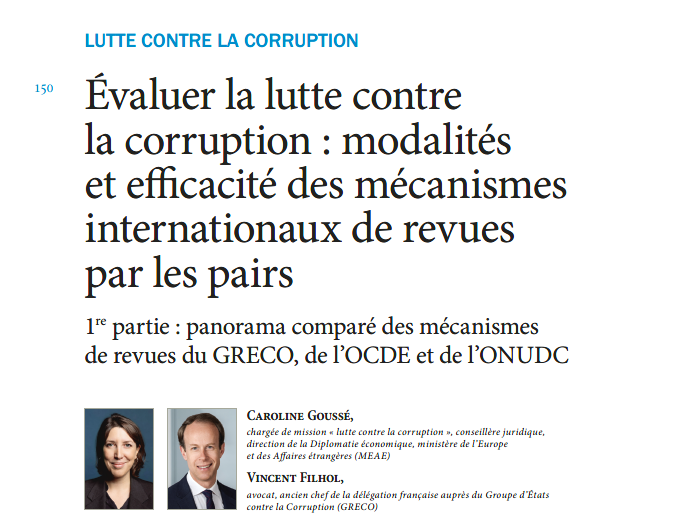
Évaluation de la lutte contre la corruption : modalités et efficacité des mécanismes internationaux d’examen...
La Revue internationale de la compliance et de l’éthique des affaires a récemment publié un article co-écrit par Vincent Filhol...
Revue de presse
13 février 2026
Revue de presse – Semaine du 9 février 2026
La revue de presse de cette semaine revient sur l’exigence de motivation dans le cadre d’une prolongation de détention provisoire...
Actualité
10 février 2026
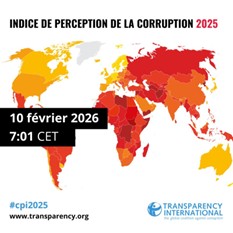
Indice de perception de la corruption 2025 : la France chute à la 27ᵉ place
Transparency International a publié l'IPC pour l’année 2025 qui met en lumière les progrès limités et les reculs persistants en...
Événement
9 février 2026
L’évolution du FCPA et les changements dans la lutte contre la corruption dans un contexte...
La conférence anti-corruption de l'International Bar Association, qui s'est tenue en Asie à Tokyo, a été l'occasion d'un riche débat...