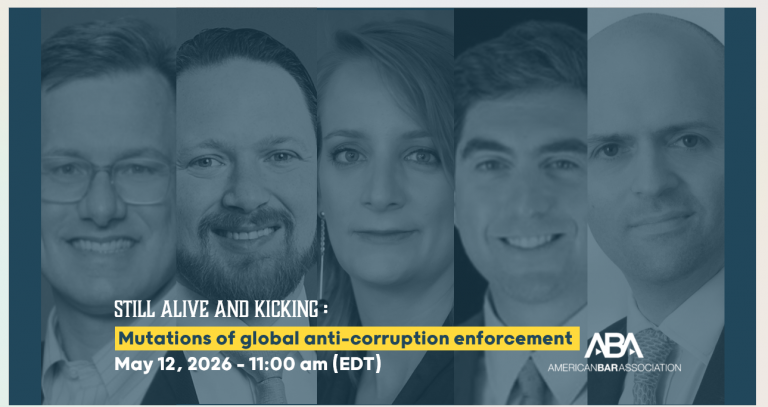
Alongside speakers from the corporate, investigative and advisory sectors, Stéphane de Navacelle contributed to an in‑depth discussion on the ongoing transformations of the international financial landscape during the IBA’s 22nd Annual Anti‑Corruption Conference held in London.
The discussions highlighted the emerging risks associated with investment funds, crypto‑assets and shadow banking, within a globalized and fragmented environment marked by uneven oversight and limited transparency. Shadow banking—understood as financial intermediation occurring outside the traditional banking system—was described less as an illicit category than as a zone of heightened vulnerabilities, interacting with grey areas and opaque financial circuits.
A persistent duality also characterizes the crypto ecosystem: despite the existence of a formal regulatory framework (AML/CFT obligations, registration, supervision), a significant portion of activities remains offshore, decentralized (DeFi) or structurally outside the regulatory perimeter. The European framework, particularly through MiCA, reflects a shift toward progressive regulatory harmonization, marked by the coexistence of national and EU‑level regimes and by uncertainties surrounding its effective implementation.
Investment structures such as private equity and hedge funds may, in certain circumstances, be used to circumvent traditional compliance mechanisms, exposing the limitations of AML regimes historically focused on banking institutions. This evolution illustrates a broader shift from a preventive compliance model to a detection‑driven approach, in which data analytics, investigative capabilities and prosecutorial authorities play an increasingly central role in anti‑corruption and anti‑money laundering enforcement.