Analysis
14 July 2019

Société Générale DPA for violations of Cuban embargo – manipulation of the law in global economic warfare

Bastille Day Newsletter 2019 - Enforcement / Court Decisions


Three months after agreeing to settle for 1.3 billion dollars in the Libyan and LIBOR case 1, Société Générale signed another Deferred Prosecution Agreement (“DPA”) on November 18, 2018, with the US Attorney’s Office of the Southern District of New York (“SDNY”) for Cuba’s embargo violation 2.

Extraterritorial application of U.S. laws on embargo

As a matter of international law, an embargo should apply only to nationals of the concerned State or the nationals of the States imposing the measure, who must refrain from any commercial exchange with the State or entities subject to the measure says the leading French legal publication 3. The general sentiment in France is that in the case concerning Société Générale, the US have gone beyond that principle.

Sanction of the French bank justified by the use of the U.S. trade system

Put in place in 1962, the embargo on Cuba prohibits in particular most imports and exports between the U.S. and Cuba and has been strengthened several times 4. As a unilateral decision, it is supposed to be applicable only to US nationals.

By stating however that Société Générale “engaged in a deliberate practice of concealing the Cuban nexus of U.S. dollar payments that were made in connection with those facilities5 the agreement enshrines the US dollar as the tool of one of the US’s exports.

In the Société Générale case, the French bank has been accused of having, from 2004 to 2010, granted payment facilities to Cuban entities and hidden transactions, that should they have been revealed, would have been prohibited by the Office of Foreign Assets Control (“OFAC”).

Nearly 2,500 transactions occurred and are presumed to have used the U.S. trade system, amounting to a total of 13 billion dollars. Most of these transactions financed oil purchases or sales between a Dutch trading company and the Cuban state-owned company with a monopoly on crude oil production and refining.

The investigations revealed that a majority of the transactions were put an end to in 2007 in fear of the US authorities, which were at that time investigating violations of the Iranian embargo in various companies.

European companies and French banks in particular, have already faced investigations by US authorities and this is not the first time that such a fine is imposed. On June 30, 2014, BNP Paribas accepted to pay a 8.9 billion fine for violation of the U.S. embargoes on Cuba, Sudan and Iran 6 and in October 2015, Crédit Agricole, faced with similar charges, negotiated a 787 million dollar deal 7.

Economic and legal battle

More recently, on May 2, 2019, the US government reactivated Title III of the Helms-Burton Act, passed in 1996 but never implemented 8, paving the way for claims to be brought before US courts by US nationals against foreign persons and entities that have made profits by trading with nationalized Cuban companies.

This law enables proceedings to be brought against any foreign company (including European and Canadian) that manage business in Cuba – from hotel and tourist venues to rum distilleries and cigar factories 9.

At the announcement of this DPA and considering the application of unilateral measures against Cuba running contrary to international law, the EU has decided to react and threatens to bring the case before the World Trade Organization – marking a short-lived attempt at a recast of the global economic and legal landscape 10.
Related content

Publication
29 January 2026
Regulatory Implications of a Tainted Arbitration: Lessons from the TotalEnergies Case
Navacelle contributes to The Legal Industry Reviews' 11th edition, focusing on a rare example of the diversion of international arbitration,...
Analysis
5 December 2025
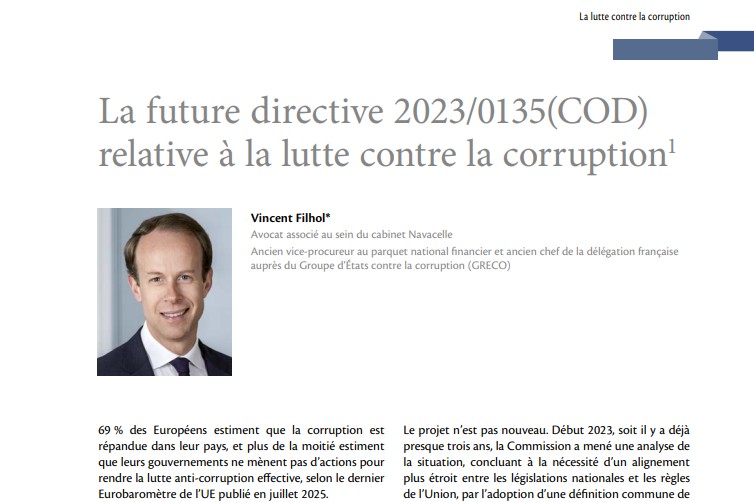
The forthcoming Directive 2023/0135 (COD) on combating corruption
In its latest issue of L'Observateur de Bruxelles, the Delegation of French Bars (Délégation des Barreaux de France) has published...
Analysis
5 November 2025
Modernization and strengthening of the French Financial Markets Authority’s powers
On September 16, 2025, a bill was introduced in the National Assembly to increase the powers of the AMF and...
Publication
13 September 2024
Cross-country insights: Addressing Corruption Allegations in Arbitration Disputes
This guide aims at providing a comprehensive understanding of how different countries handle allegations of corruption in the course of...
Press review
10 April 2026
Press Review – Week of 10 April 2026
This week’s press review focuses on the adoption at first reading of the bill to combat social security and tax...
Analysis
9 April 2026
Non-solicitation agreements and anti-competitive practices: A review of the June 11, 2025 decision issued by...
In the context of increased scrutiny by competition authorities of practices affecting labor markets, a webinar organised by the Antitrust...
Press review
3 April 2026
Press Review – Week of 3 April 2026
This week’s press review covers the adoption by the European Parliament of the European Union’s first anti-corruption directive; the expansion...
Event
3 April 2026
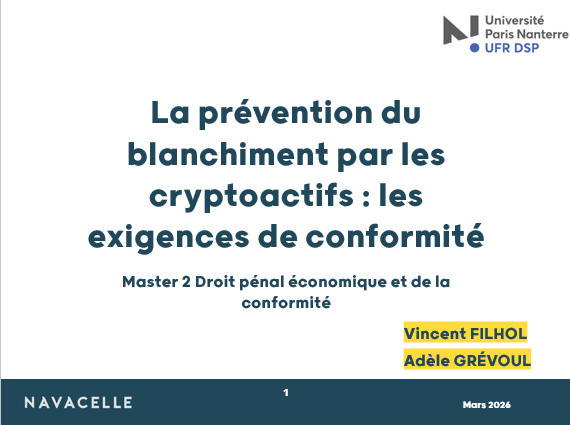
Money Laundering in the age of cryptocurrency
Conference on anti-money laundering, presented to students in the Master 2 program in Economic Criminal Law and Compliance at Paris...
2 min
Analysis
31 March 2026
CACEIS Bank: Decision of the AMF Enforcement Committee of December 17, 2025
Following the H2O AM case, which resulted in a sanction against this management company in 2022, the AMF examined the...
Event
30 March 2026
[PAW 2026] The New Geopolitics of Arbitration
Conference on the New Geopolitics of Arbitration, held at the Paris Court of Economic Affairs, as part of the Paris...
2 min
Press review
27 March 2026
Press Review – Week of 27 March 2026
This week’s press review covers the publication by the Direction Générale de la Sécurité Intérieure (DGSI) of a report warning...
Press review
20 March 2026
Press Review – Week of 16 March 2026
This week’s press review covers the ruling of the French Cour de cassation on the so-called “fake bank advisor” fraud;...
Analysis
19 March 2026
Review of the CJIP agreement between HSBC and the PNF for aggravated tax fraud
In the context of the CumCum case, the French National Financial Prosecutor’s Office (PNF) and HSBC Bank plc concluded a...
Press review
13 March 2026
Press Review – Week of 9 March 2026
This week’s press review covers the conviction of the Rocher Group for failure to comply with its duty of vigilance,...
Event
11 March 2026
Paris Arbitration Week 2026 – The fight against bias and noise, which unconsciously cloud the...
Navacelle is hosting a panel on 26 March 2026, as part of the Paris Arbitration Week (PAW).
Event
10 March 2026
Paris Arbitration Week 2026 – Fraus omnia corrumpit… Really? Paris courts and the enforcement of...
Navacelle is hosting a panel regarding Corruption and Arbitration on 24 March 2026, as part of the Paris Arbitration Week (PAW).