Analysis
14 July 2019

Seizure of property that amounts to indirect and partial proceeds of the offence must be proportional

Bastille Day Newsletter 2019 - Enforcement / Court Decisions


On June 27, 2018, the criminal chamber of the French Supreme Court (Cour de Cassation1 held that criminal courts must consider the principles of necessity and proportionality when ruling on the seizure of property acquired by lawful and unlawful funds.

This ruling comes pursuant to the legislator widening the scope of the legal application of seizure of property to include property which amounts only in part to the object or direct or indirect proceeds of the offence2 – leading to a potential infringement of the fundamental right to property3.

Examining the challenged investigating chamber’s decision (chambre de l’instruction) to seize company property as the proceeds for the offence of illegal acquisition of interest, the French Supreme Court ruled on several aspects.

Firstly, considering the difficulty to identify the proceeds for complex offences, the Court reasserted the necessary loose interpretation of “proceeds”. In the case at hand, the Court held that the proceeds were the company benefits from the litigious transaction rendered possible by the initial fraud.

Secondly, the Court reiterated that is not required to state the grounds when ruling on the seizure of property constituting in its entirety the proceeds or object of the offence or when ruling on the seizure of the equivalent value of the proceeds of the offence.

The French Supreme Court however ruled that the investigating chamber should have considered the principle of proportionality when ruling in favor of the seizure of property that only constituted in part the proceeds of the offence – because partially acquired with lawful funds.

A second ruling on the same day by the French Supreme Court4 identified the conditions to be verified for the seizure of property acquired by lawful and unlawful funds. The judge must establish the seizable nature of the property in accordance with the legal requirements, the disclosure of the nature and origin of the property and the basis of the measure and the demonstration where appropriate, of the necessity and proportionality of the infringement of the accused’s right of ownership.

Criminal courts must now demonstrate their assessment that the seizure – be it at the investigation or at the adjudication stage and in any event, before its authorization – of the part of the property that does not constitute the proceeds of the offence is a proportional infringement of the accused’s property rights.

If it were to be considered an unwarranted infringement, remains the difficulty that real estate acquired by legal and illegal funds cannot be subject to partial criminal seizure. This lays the ground for potential substitution of seized property by other assets of estimated equal value to the proceeds of the offence.
Related content

Publication
29 January 2026
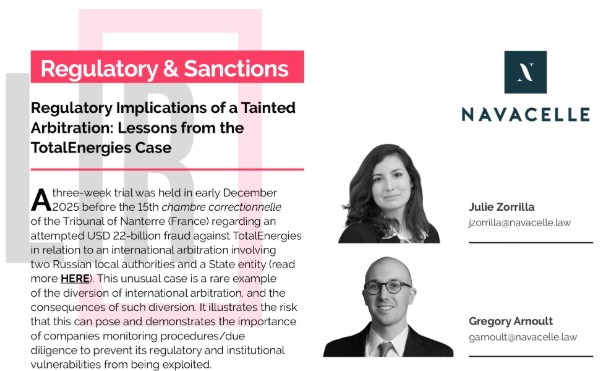
Regulatory Implications of a Tainted Arbitration: Lessons from the TotalEnergies Case
Navacelle contributes to The Legal Industry Reviews' 11th edition, focusing on a rare example of the diversion of international arbitration,...
Analysis
5 December 2025
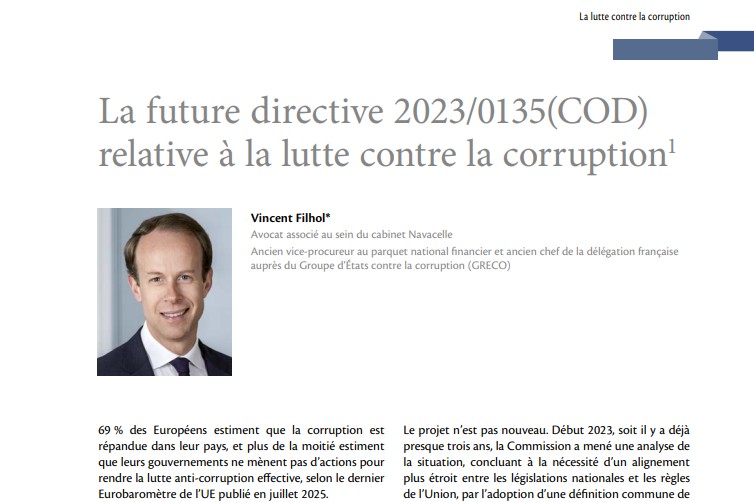
The forthcoming Directive 2023/0135 (COD) on combating corruption
In its latest issue of L'Observateur de Bruxelles, the Delegation of French Bars (Délégation des Barreaux de France) has published...
Analysis
5 November 2025
Modernization and strengthening of the French Financial Markets Authority’s powers
On September 16, 2025, a bill was introduced in the National Assembly to increase the powers of the AMF and...
Publication
13 September 2024
Cross-country insights: Addressing Corruption Allegations in Arbitration Disputes
This guide aims at providing a comprehensive understanding of how different countries handle allegations of corruption in the course of...
Press review
20 February 2026
Press Review – Week of 16 February 2026
This week’s press review covers the Financial Action Task Force (FATF) praising Monaco’s progress in combating money laundering, the dismissal...
Publication
19 February 2026
Assessing the fight against corruption: modalities and effectiveness of international peer review mechanisms
Revue internationale de la compliance et de l’éthique des affaires recently published an article co-authored by Vincent Filhol and Caroline...
Press review
13 February 2026
Press Review – Week of 9 February 2026
This week’s press review covers the requirement to provide grounds when extending pre-trial detention; the opening by the French National...
News
10 February 2026
Key Findings from the 2025 Corruption Perceptions Index
Transparency International has released the CPI for 2025, which highlights limited progress and persistent setbacks in the fight against corruption,...
EventNews
9 February 2026
The evolution of the FCPA and changes in anti-corruption enforcement in a changing geopolitical landscape
The IBA Anti-Corruption Asia Conference in Tokyo provided a rich forum for discussion on the evolution of the FCPA and...
Press review
6 February 2026
Press Review – Week of 2 February 2026
This week’s press review covers the prosecution’s submissions in the appeal trial of Marine Le Pen, a Cour de cassation...
Event
5 February 2026
Focus on French Compliance regulators
A conference for ESMD on French Compliance regulators' roles and tools, as well as interactions with judicial authorities and a...
2 min
Press review
30 January 2026
Press Review – Week of 26 January 2026
This week’s press review covers the opening of the appeal trial of four individuals convicted for their involvement in the...
Press review
23 January 2026
Press Review – Week of 19 January 2026
This week’s press review covers Free’s conviction by the CNIL for serious breaches of the GDPR’s security requirements; the French...
Press review
16 January 2026
Press Review – Week of 12 January 2026
This week’s press review covers the judicial public interest agreement entered into by HSBC in connection with dividend-related tax fraud...
Analysis
12 January 2026
Clarifications on attorney-client privilege and the prerogatives of the judicial judge in tax matters
In a ruling dated 8 October 2025, the French Court of Cassation clarified the scope of attorney-client privilege, the judge’s...