Since the summer of 2025, white collar crime has not undergone any major comprehensive reform. Nevertheless, several legislative, regulatory, and jurisprudential developments reflect a targeted and convergent strengthening of oversight and enforcement mechanisms.
On the legislative front, Law No. 2025-532 of 13 June 2025, known as the “drug trafficking” law, fundamentally overhauled the framework for combating money laundering and organized crime and consolidated the treatment of money laundering as a core offense. At the same time, the bill on combating social security and tax fraud, which was finally adopted in the spring of 2026, had for a time contemplated the abolition of the judicial public interest agreement (convention judiciaire d’intérêt public, CJIP).
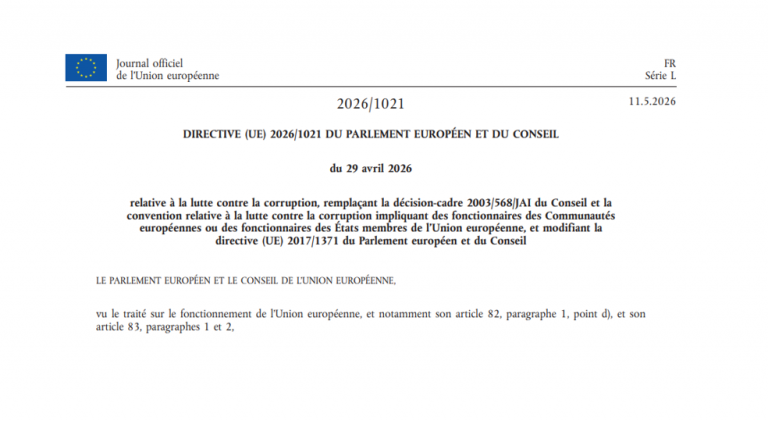
At European level, the first anti-corruption directive was formally adopted on 21 April 2026, opening a new phase of binding harmonization of national criminal laws.
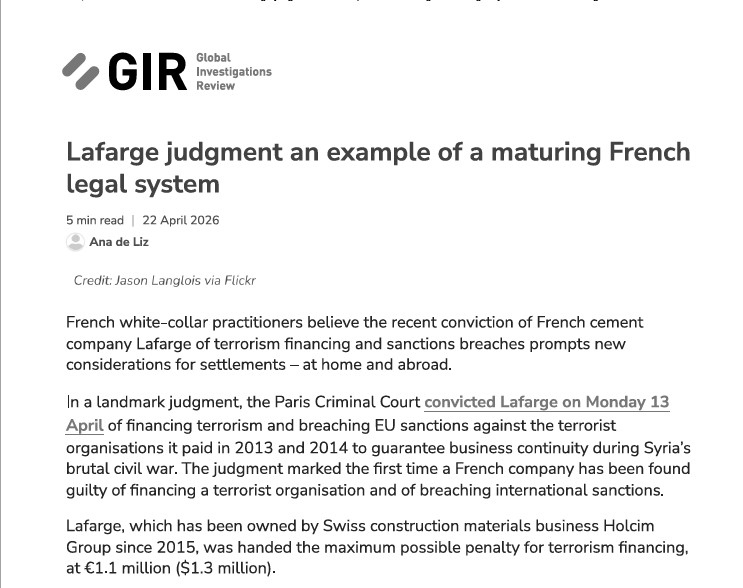
Finally, on the judicial front, the year was marked by significant decisions: the upholding of Nicolas Sarkozy’s conviction in the Bygmalion case, the landmark conviction of Lafarge for financing terrorism, and the signature of two judicial public interest agreements in the Cum Cum and Surys cases. At the same time, data published by Transparency International, the Court of Auditors, and the French Anti-Corruption Agency reveal a worrying deterioration in the perception of public integrity and probity.
Combating fraud against public finances: legislative strengthening and judicial enforcement
The bill on combating social security and tax fraud
Combating social security and tax fraud has held a central place in the year’s developments.
Adopted at first reading by the National Assembly on 7 April 2026, and subsequently expanded during parliamentary debates, this bill seeks to enhance the effectiveness of the public response to increasingly complex fraud schemes. It is structured around three main pillars: improving information sharing among government agencies, strengthening investigative resources, and toughening penalties where a structured fraudulent organization is involved.
For companies and their executives, vigilance extends beyond mere compliance with their own obligations. Criminal liability may indeed arise from relationships with service providers, subcontractors, or intermediaries involved in illegal employment, fraud, receiving stolen goods, or money laundering.
Despite the signature of several CJIPs, the question of its abolition was debated by the legislature
Several CJIPs have been signed and approved in recent months.
Thus, on 3 September 2025, the Paris Judicial Court approved the CJIP concluded on 8 July 2025 by Surys, for bribery of a foreign public official, the misappropriation of public funds, and money laundering of the proceeds of those offenses, committed in Ukraine via an Estonian intermediary. In addition to a public interest fine of 18,363,007 euros and a three-year compliance program overseen by the AFA, the agreement provided for direct and unprecedented compensation to the Ukrainian government, the victim of the offenses, in the amount of approximately 3.3 million euros
On 8 September 2025, the Paris Judicial Court also approved the CJIP concluded by Crédit Agricole CIB for acts of money laundering of the proceeds of aggravated tax fraud, imposing a fine of 88.2 million euros. On 8 January 2026, HSBC Bank plc in turn signed a CJIP providing for a fine of 267.5 million euros for laundering the proceeds of aggravated tax fraud relating to intra-group trading arrangements used to avoid taxation on dividends between 2014 and 2019. The National Financial Prosecutor’s Office (PNF) has confirmed its determination to prosecute the other institutions under investigation (BNP Paribas, Société Générale, and Natixis), the total financial stakes exceeding four billion euros.
The CJIP now plays a central role in the handling of certain economic and financial offenses, particularly in cases of corruption, tax fraud, money laundering of the proceeds of tax fraud, and, more broadly, breaches of probity and integrity. It enables a legal entity to be required to pay a public-interest fine, compensate for the damage caused, and, where appropriate, implement a compliance program, without any finding of guilt.
Ten years after the Sapin II Act, nearly 70 CJIPs have been concluded in France. This instrument has, in particular, facilitated the emergence of structured cooperation with foreign prosecuting authorities in several major cases. Although widely used, its continuation was nevertheless called into question during the legislative process. In April 2026, as part of its review of the bill on combating social security and tax fraud, the National Assembly adopted an amendment seeking purely and simply to abolish the CJIP, which its critics portrayed as a symbol of a two-tier justice system. The amendment provided for the repeal of Articles 41-1-2, 41-1-3, and 180-2 of the Code of Criminal Procedure. However, it was ultimately set aside by the Joint Committee on April 28, 2026.
For a large proportion of practitioners, the retention of the CJIP confirms that it is a particularly effective tool for addressing financial and environmental offenses, by fostering the accountability of legal entities. Its abolition would therefore have undermined France’s credibility on the international stage. This episode nonetheless reveals a genuine institutional fragility of this instrument, which only a substantive reform will be able to remedy in the long term.
Combatting money laundering and organized crime: the rise of a “pivotal offense”
The “Drug trafficking law”: direct implications for white collar crime
Law No. 2025-532 of 13 June 2025, known as the “Drug Trafficking law”, establishes and reinforces the understanding of money laundering as a true “pivot offense”. Recent developments in this area confirm that economic and financial offenses are no longer viewed solely as standalone offenses, but also as tools for concealing, circulating, and reinvesting illicit profits.
Several innovations reflect this shift. The creation of the National Anti-Organized Crime Prosecutor’s Office (Parquet national anti-criminalité organisée, PNACO), the recognition of the concealed nature of money laundering, and the extension of the presumption of money laundering to transactions involving crypto-assets that rely on anonymization mechanisms all attest to this evolution.
The drug trafficking law thus reinforces the asset-based approach to criminal enforcement. The objective is no longer merely to identify the direct perpetrators of trafficking, but also to trace financial flows, detect suspicious assets, and durably deprive criminal organizations of the resources that sustain their operations.
Strengthening the AML/CFT framework and the first conviction for real estate money laundering based on presumption
This same period was marked by the first conviction handed down by the Paris Criminal Court based on the presumption of real estate money laundering. Following this decision, in May 2026, the Paris Court of Appeals upheld the seizure of a villa and assets belonging to Russian oligarchs on the basis of a presumption of money laundering, confirming the extension of the presumptive regime to complex asset structures with an international dimension.
Reporting vigilance has likewise increased. In 2024, Tracfin recorded a record number of suspicious activity reports. Meanwhile, in an advisory opinion dated 23 January 2025, the Council of State reiterated the scope of the obligations imposed on regulated professionals. The growing strength of the AML/CFT framework is now undeniable, even for regulated professions subject to professional secrecy.
The Europeanization of white collar crime
The new European anti-corruption directive: a gradual harmonization of white collar crime
The adoption of the first European directive dedicated to combating corruption by the European Parliament on 26 March 2026, and its approval by the Council on 21 April 2026, constitutes one of the year’s most notable developments.
The text establishes a common framework of criminal offenses, covering in particular active and passive corruption in both the public and private sectors, the misappropriation of funds, influence peddling, obstruction of justice, concealment, and illicit enrichment resulting from acts of corruption. It also strengthens the liability of legal entities, particularly when the offense was made possible by a failure to exercise due supervision or control.
For companies, the consequences are significant. The directive provides for financial penalties that may be calculated based on global revenue, while taking into account compliance efforts, cooperation with the authorities, and the implementation of corrective measures after the facts have come to light.
The strengthening of public prevention policies
The year was also marked by the entry into force of the 2025–2029 National Anti-Corruption Plan, presented on 14 November 2025, which is structured around four strategic pillars, namely: strengthening integrity within public administration, supporting local authorities, protecting economic actors, and combating corruption internationally.
This plan comes at a challenging time, with several indicators revealing a deterioration in perceptions of public integrity. These developments serve as a reminder that compliance is no longer merely a tool for preventing criminal liability but has now become a central element of corporate governance.
Some noteworthy case law
Public Integrity: The Bygmalion Case
On 26 November 2025, the criminal division of the Cour de Cassation dismissed Mr. Nicolas Sarkozy’s appeal, making his one-year prison sentence, including six months’ custodial term, eligible for adjustment of sentence, final for the illegal financing of his 2012 presidential campaign. This decision, which pertains more to the financing of political life than to white collar crime stricto sensu, is part of a series of legal developments marked by his first-instance conviction in the Libyan funding case and by debates over the provisional enforcement of sentences.
Lafarge: the first conviction of a multinational for the financing of terrorism
On 13 April 2026, the Paris Criminal Court sentenced Lafarge to the maximum fine of 1.125 million euros for financing terrorism, on account of payments made to jihadist groups in 2013 and 2014 to keep a Syrian cement plant operating in a war zone. The company was also ordered to pay a customs fine of 4.57 million euros jointly and severally with four former executives for violating international sanctions. Finally, the former CEO was sentenced to six years’ immediate imprisonment with immediate incarceration. This is the first conviction in France of a company for financing terrorism.
Two issues remain unresolved: first, the question of ne bis in idem (in light of the 2022 U.S. settlement), and second, the proportionality of the maximum fine.
All those convicted have appealed against this decision.
The year 2025–2026 confirms a strong commitment towards greater enforcement in white collar crime and greater accountability of those implicated.
More than a mere toughening of penalties, this trend reflects a shift in the very logic of economic enforcement. Authorities now expect companies to identify, prevent, and manage the criminal risks to which they are exposed on their own.